Read these articles hand-picked by the editors |  | Editor's Highlight Their Top Picks | Editors' picks are chosen for being particularly noteworthy or significant to the field. | Check out these recently published editor's picks articles carefully curated by the American Journal of Physics (AJP) editorial team. Each article below is accompanied with a summary designed to help readers easily see which articles will be most valuable to them. | | With a 9.1 author satisfaction rating, your research is supported by a journal that values quality and transparency. | | | | | | |  Scattering from the charge radius of a neutral particle Scattering from the charge radius of a neutral particle Max Ketterer, David C. Latimer
READ MORE >
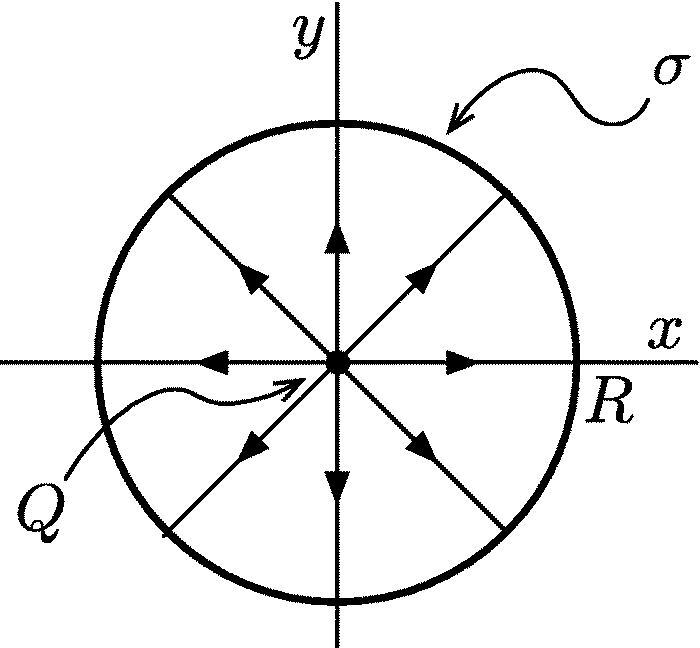
| Few systems lend themselves to analysis within classical mechanics, quantum mechanics, and also quantum field theory. Rutherford scattering is a notable exception. This article introduces another: a point charge surrounded by a compensating shell of opposite charge. Though the net charge is zero, scattering calculations reveal the influence of the internal charge distribution. The authors present parallel treatments using classical scattering theory, the Born approximation, and quantum field theory‚ emphasizing physical insight alongside mathematical analysis. The model can serve as a useful teaching example in any of these contexts and highlights how classical and quantum analyses can diverge, in contrast to the familiar case of Rutherford scattering. |
| | Energy needed to propel a tiny spacecraft to Proxima Centauri C. J. Umrigar, Tyler A. Anderson
READ MORE >
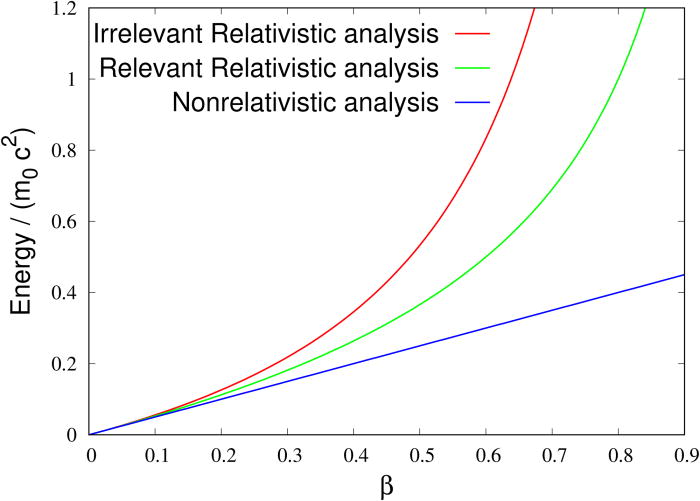
| Could we send a spacecraft to another star? Sending a person to the nearest star is the stuff of science fiction. But it turns out that sending a 2 g spacecraft, while not possible with current technology, is perhaps within reach. To do this, we could shine a powerful laser on the spacecraft's sail, accelerating it to perhaps 0.2c. How much light energy would be required? This paper shares the details that will allow students in an introductory course on special relativity to calculate the answer. |
| | A very simple derivation of the periastron advance to all post-Newtonian orders of perturbation in Schwarzschild geometry Steven A. Balbus
READ MORE >
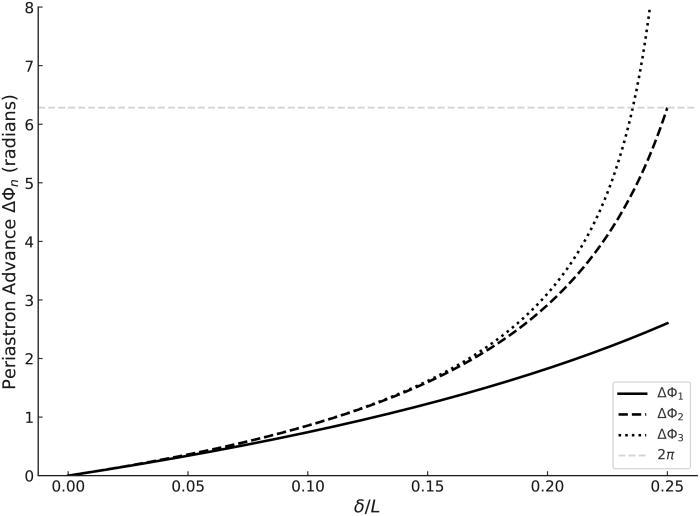
| Explaining the advance of orbital perihelion was one of the major early successes of the theory of general relativity, and it remains a fixture of GR courses at the advanced undergraduate and graduate level. However, this explanation has not been something we could share in earlier physics courses. This paper presents a simple mathematical technique that will allow instructors in lower level undergraduate courses to share an interactive analysis of an orbital perihelion advance that can be calculated with arbitrary accuracy. One immediate noteworthy application is the analysis of this advance for stars orbiting the black hole at our galactic center. |
| | Quantum solutions for the delta ring and delta shell Luis F. Castillo-Sánchez, Julio C. Gutiérrez-Vega
READ MORE >
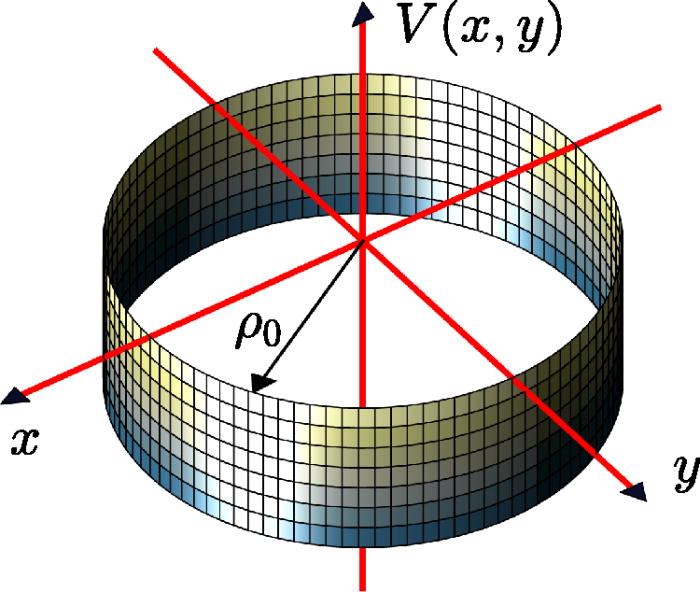
| Analyzing the one-dimensional Dirac δ-function potential is a rite of passage in quantum mechanics. Its bound state energy and reflection and transmission coefficients are familiar to most physicists. But what about the higher-dimensional analogs of the familiar spike in one dimension: a two-dimensional Dirac ring or a three-dimensional Dirac bubble? In this paper, the authors derive the bound state spectrum as well as the transmission and reflection coefficients for these potentials to reveal similarities and surprising differences in the behavior of particles in one, two, and three dimensions. The analysis is suitable for an undergraduate or graduate quantum mechanics course, adding two more exactly solvable potentials for the quantum canon. The calculations also provide interesting applications of Bessel functions and spherical harmonics that could augment courses in mathematical methods. |
| | Online "Advanced Labs" in physics Peter A. Bennett
READ MORE >
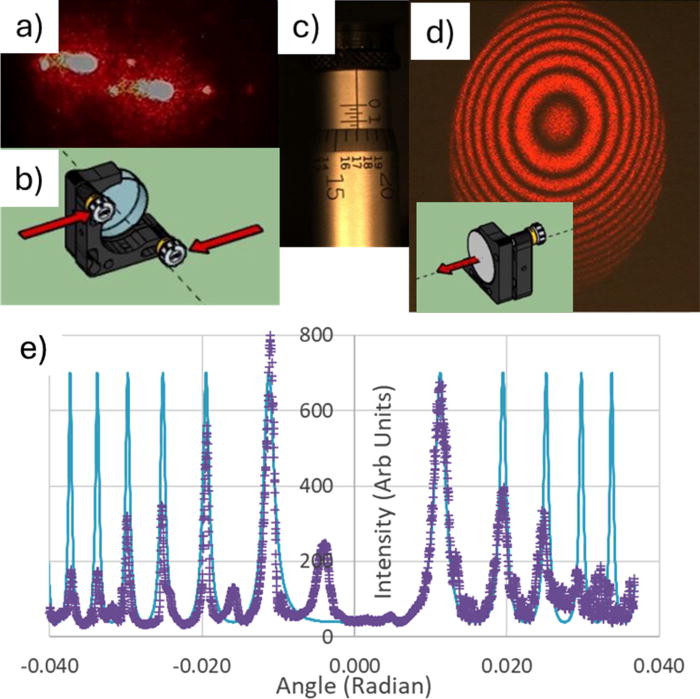
| The rapid growth of online instruction creates a challenge for physics departments: Is it possible to replace the advanced lab with an online offering? This paper not only describes a successful online offering but also shares the complete set of materials with other instructors. Even instructors who teach in-person may choose to supplement their offerings with some of the exercises and techniques shared in this paper. The link to the paper will also take readers to a video abstract. |
| | The right way to introduce complex numbers in damped harmonic oscillators Jason Tran, Leanne Doughty, James K. Freericks
READ MORE >
| Complex exponential functions are convenient for analyzing the classical harmonic oscillator, but can the method be introduced to students in an intuitive way? In this note, the authors show how a method described by Max Born and Pascal Jordan in their 1930 textbook on quantum mechanics accomplishes this—and reveals a deep connection between classical and quantum mechanics. The material fits naturally into undergraduate courses in classical or quantum mechanics and could also be used in graduate courses to introduce the factorization method for exactly solvable quantum systems. |
| | Solving introductory physics problems recursively using iterated maps L. Q. English, D. P. Jackson, D. Richeson, W. A. Morgan, et al.
READ MORE >
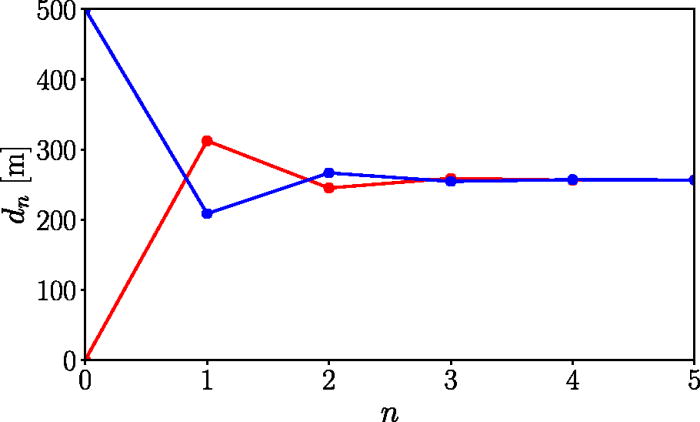
| In middle school or high school, students sometimes use a method of "guess and check'" as a way to find the answer to a problem that they have difficulty solving. In college courses, the "guess and check" method is usually discouraged in favor of algebraic methods that arrive at an exact answer. Yet, this article discusses more advanced and systematic iterative methods, and how students can use them to solve classic introductory physics problems. A beautiful analysis is performed studying the conditions under which the iterative methods converge to the correct answer, and when they fail. There is something for everyone here, as the article contains pedagogical suggestions for teaching introductory physics and iterative methods, along with more advanced topics of interest to experts in nonlinear dynamics and chaos. |
| |  A simple Minkowskian time-travel spacetime A simple Minkowskian time-travel spacetime John D. Norton
READ MORE >
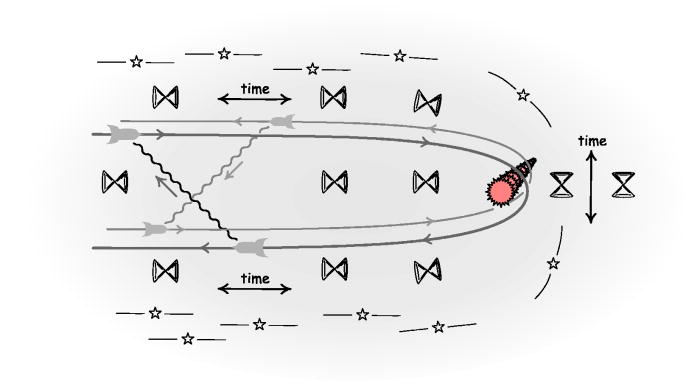
| Time travel is enormously interesting to physics students, but many instructors don't feel like we can say anything about it. This article could be used in a course on general relativity to introduce a clever alteration of a flat two-dimensional spacetime diagram. One omits the negative spatial left half and then joins the edges to form a flat spacetime cone. The result is that if such a relativistic spacetime could exist, then an aging student could encounter a second continually younger version of his or her self. The unphysical feature of this model, as illustrated by the author, is the presence of a spacetime singularity at the tip of the cone. |
| | The surprising subtlety of electrostatic field lines Kevin Zhou, Tomáš Brauner
READ MORE >
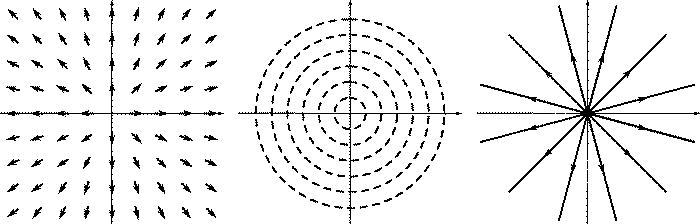
| Field lines are ubiquitous in introductory physics, but mainly as sketches to aid intuition. In this article, the authors explore the surprising and subtle mathematics of field lines. They focus on two questions from electrostatics: (1) When does a set of field lines represent a conservative field? (2) What systems give rise to straight field lines? The canonical examples of Gauss' law—spherical, planar, and line charge distributions—are familiar to physicists, but are there others? To answer these questions, the authors turn to differential geometry. They provide a self-contained introduction to integrability and curvature, starting from vector calculus. The elegant mathematics provides new insights into electrostatics and minimal surfaces, and the material could be used to supplement a wide range of courses. The mathematics will be familiar to students who have taken a junior-level electrodynamics or math methods course, and the methods and results can be applied across the gamut of theoretical physics. |
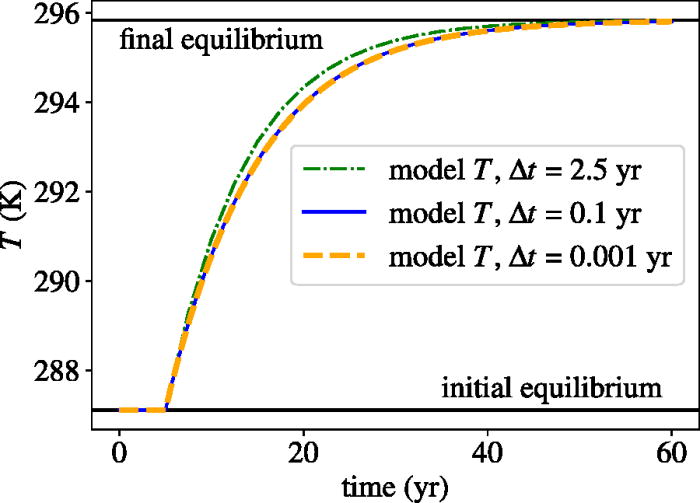
| | Introducing key theoretical and data analysis tools in computational physics via Earth's temperature and climate David Syphers
READ MORE >
| This paper provides two introductory computing activities on topics that students will find both compelling and understandable. The author has identified common pitfalls in computing and carefully designed exercises that will help students avoid them. The activities can be used together or separately. They are appropriate not only for courses that focus on computing but also for those that focus on climate, if the instructor wishes to introduce computational exercises. |
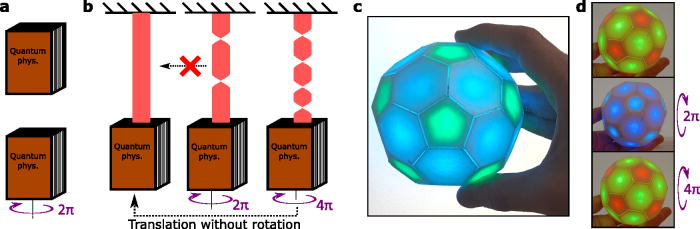
| | The spinorial ball: A macroscopic object of spin-1/2 Samuel Bernard-Bernardet, Emily Dumas, Benjamin Apffel
READ MORE >
| If you ever wanted to hold a spin-1/2 particle in your hands, this paper is for you. If you follow the authors' instructions, you will end up with a polyhedron with faces that light up according to rules defined in the SU(2) group, and which you will be able to rotate at will (and thus explore the SO(3) rotation group). The so-called spinorial ball then behaves as a spin-1/2 object in that it has to experience a 4π rotation about a given axis to come back to its initial state. As you will be able to show by playing with the ball, this important property of spins-1/2 is actually a consequence of the interplay between two rotation groups. This paper, which will help you build a demonstration experiment for introductory quantum mechanics classes, could also be the basis of an exercise in undergraduate group theory classes or electronics labs. |
| | |
Interested in Becoming an AAPT Member? |
American Association of Physics Teachers (AAPT) is the premier global professional society established to advance the greater good through physics education. Member benefits include free online access to The Physics Teacher and American Journal of Physics, leadership/networking opportunities, discounts on educational products, career advancement opportunities, and much more! |
|
|
| | | | |  | Follow us on social media | | | Copyright © 2025 American Association of Physics Teachers. All rights reserved. One Physics Ellipse, College Park, MD 20740
You are receiving this email because you have opted-in to receive alerts from us. To guarantee delivery of this email please add aaptpubs@aip-info.org to your address book and safe senders list.
If you no longer wish to receive emails from us then please unsubscribe or amend your settings.
Privacy Policy
| | | | |



No comments:
Post a Comment